
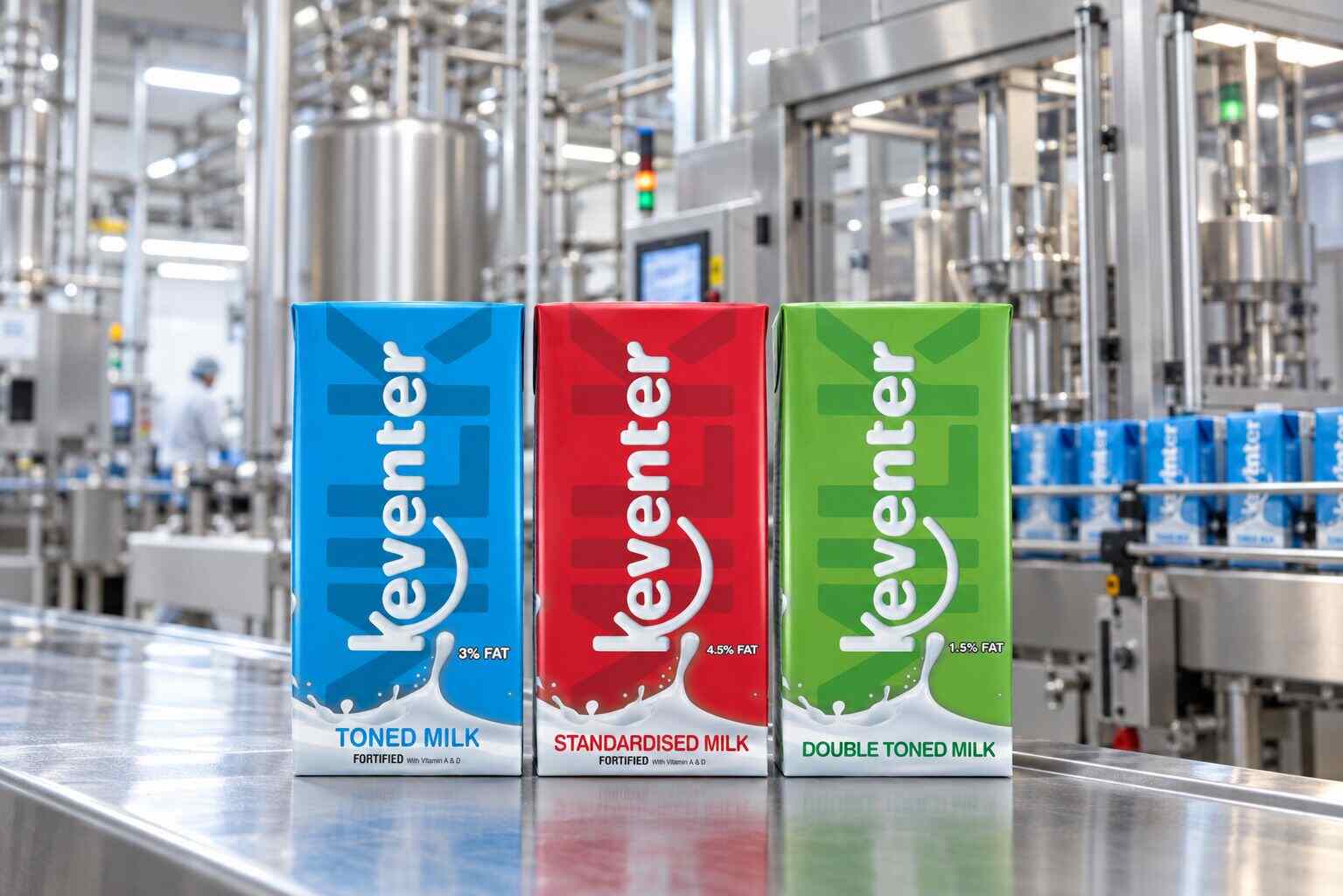
UHT milk may look simple on the shelf, but making it requires advanced technology.
The milk has to be processed safely, packed hygienically and protected in a way that allows it to stay usable for longer without refrigeration before opening. This is where a modern UHT factory becomes important.
Keventer’s UHT factory can be positioned as one of the most advanced dairy processing facilities in Eastern India because of the kind of systems needed for UHT milk production.
The process begins with milk reception and quality checks.
Before milk moves into processing, it has to be tested for basic quality parameters. This helps ensure that only suitable milk enters the production line. From there, the milk goes through controlled processing stages such as filtration, standardisation and homogenisation.
Homogenisation helps create a smoother and more uniform milk texture.
Then comes the UHT process.
UHT stands for Ultra High Temperature. In this process, milk is heated to a very high temperature for a short time and then cooled quickly. This helps make the milk commercially sterile while maintaining its usability for long-life packaging.
After processing, aseptic packaging becomes the next important step.
The milk must be filled into sterilised packs in a sterile environment. This is where advanced filling machines, closed pipelines, aseptic tanks and automated packaging systems play an important role. The aim is to protect the milk after processing and avoid contamination during filling.
A modern UHT factory may also include equipment such as:
Milk reception systems
Chilling and storage silos
Clarifiers and separators
Standardisation systems
Homogenisers
UHT sterilisation units
Aseptic storage tanks
Tetra pack or aseptic filling machines
CIP cleaning systems
Automated control panels
Quality testing laboratories
CIP, or Cleaning-in-Place, is especially important in dairy processing. It allows internal equipment and pipelines to be cleaned in a controlled way without dismantling the system each time. This supports hygiene, efficiency and consistency.
Automation also helps improve reliability.
In advanced dairy plants, many processes are monitored through control systems. Temperature, pressure, flow rate, cleaning cycles and filling conditions can be managed more precisely. This reduces manual error and supports consistent product quality.
For consumers, the benefit is simple.
They get milk that is convenient, safe to store before opening and useful for modern routines. Keventer UHT milk can be kept at home, carried while travelling, used in offices or stored as a dependable backup.
The strength of a UHT factory is not visible from the outside of the pack.
But every pack depends on the technology behind it.
From processing to aseptic filling, Keventer’s UHT factory reflects how dairy production has moved forward in Eastern India: cleaner systems, better control, modern packaging and milk made for today’s homes.